
Overview
FastSurvival provides fast alternatives to the standard survival analysis functions in the survival package, together with a simulation layer for designing and evaluating time-to-event trials. Every function is designed for repeated evaluation inside large simulation loops, where the iterative or object-building overhead of the standard implementations becomes a bottleneck. Core computations are implemented in C++ via Rcpp.
Function families
The package has two families of functions. Collett (2014) gives the methodological background of the standard methods they implement.
The estimation and testing functions operate on a single dataset and
return an S3 object with a print() method.
survfit_fast() evaluates the Kaplan-Meier estimate at a
single time point. survdiff_fast() computes the log-rank
test and its weighted and stratified variants. coxph_fast()
returns a closed-form hazard ratio, the Pike-Halley Estimator.
rmst_fast() returns the restricted mean survival time, and
wmst_fast() the window mean survival time over an interval.
milestone_fast() compares survival at a milestone
timepoint, and medsurv_fast() compares median survival
times. maxcombo_fast() computes the max-combo test,
rmw_fast() the robust modestly-weighted log-rank test, and
wkm_fast() the weighted Kaplan-Meier (Pepe-Fleming) test.
ahsw_fast() computes the average hazard with survival
weight, and ahr_fast() the Kalbfleisch-Prentice average
hazard ratio.
The simulation functions support a full simulation study.
simdata_fast() generates individual patient data for
one-group, two-group, or multi-arm trials. cutoff_fast()
determines the calendar time of every analysis look in every simulated
trial from combined event and calendar-time rules.
analysis_fast() performs interim or sequential analyses of
the simulated data at one or more looks, and can compute any of the
estimation and testing statistics above, optionally within subgroups.
switch_fast() applies treatment switching to the simulated
data, at progression or after an interim analysis.
pairwise_fast() compares each experimental arm of a
multi-arm trial with a shared control. simsummary_fast()
aggregates the operating characteristics from the analysis output
against supplied boundaries.
A minimal example
The following example uses the ovarian dataset from the
survival package, with a one-sided test of treatment benefit
(side = 1).
library(survival)

# Single-time-point Kaplan-Meier estimate
ord <- order(ovarian$futime)
survfit_fast(ovarian$futime[ord], ovarian$fustat[ord],
             t_eval = 500, conf.type = "log")
#> Kaplan-Meier survival estimate (single time point)
#>
#>         survival std.err lower 95% upper 95%
#> t = 500   0.5961  0.0999    0.4291    0.8279
#>
#>  Confidence interval type: log

# Log-rank test
survdiff_fast(ovarian$futime, ovarian$fustat, ovarian$rx,
              control = 1, side = 1)
#> Log-rank test (two-group)
#>
#>   N = 26,  control = 1
#>
#>           Observed Expected (O-E)^2/E (O-E)^2/V
#> control          7   5.2335    0.5962    1.0627
#> treatment        5   6.7665    0.4612    1.0627
#>
#>  Z = -1.031,  one-sided p-value = 0.1513
#> ---
#> Signif. codes:  0 '***' 0.001 '**' 0.01 '*' 0.05 '.' 0.1 ' ' 1

# Hazard ratio via the Pike-Halley Estimator
coxph_fast(ovarian$futime, ovarian$fustat, ovarian$rx,
           control = 1, side = 1)
#> Pike-Halley estimator for the hazard ratio (two-group)
#>
#>   control = 1
#>   alternative = one.sided
#>
#> Coefficients:
#>          coef exp(coef) se(coef)      z Pr(<z)
#> group -0.5964    0.5508   0.5868 -1.016  0.155
#>
#> Hazard ratio and 95% Wald confidence interval:
#>       exp(coef) exp(-coef) lower .95 upper .95
#> group    0.5508     1.8155    0.1744    1.7399
Formulas, data frames, and plots
For the analysis of a single data set the functions also accept a
model formula with a data frame, as the functions of the survival
package do. The control group is then the first level of the group
variable, unless control is given. Inside simulation loops
the vector interface remains the faster choice. Every result has an
as.data.frame() method that returns its estimates and tests
with the same columns, and coef() and
confint() methods for the estimates; ratios are reported on
the log scale.
fit <- coxph_fast(Surv(futime, fustat) ~ rx, data = ovarian, side = 1)
as.data.frame(fit)
#>   term estimate std.error  conf.low conf.high statistic   p.value
#> 1 coef -0.59638 0.5868442 -1.746574 0.5538135 -1.016249 0.1547553
exp(confint(fit))
#>          2.5 %   97.5 %
#> coef 0.1743704 1.739875

as.data.frame(rmst_fast(Surv(futime, fustat) ~ rx, data = ovarian,
                        tau = 500))
#>        term    estimate  std.error    conf.low   conf.high statistic    p.value
#> 1 rmst.ctrl 373.6923077         NA          NA          NA        NA         NA
#> 2  rmst.trt 472.5726496         NA          NA          NA        NA         NA
#> 3      diff  98.8803419 47.0605014  6.64345409 191.1172297  2.101132 0.03562935
#> 4 log.ratio   0.2347587  0.1238482 -0.00797928   0.4774968  1.895536 0.05802142
kmcurve_fast() builds the Kaplan-Meier curves of a data
set, and its plot() method can add the numbers at risk
below the curves.
km <- kmcurve_fast(Surv(futime, fustat) ~ rx, data = ovarian)
plot(km, risk_table = TRUE, conf.style = "band")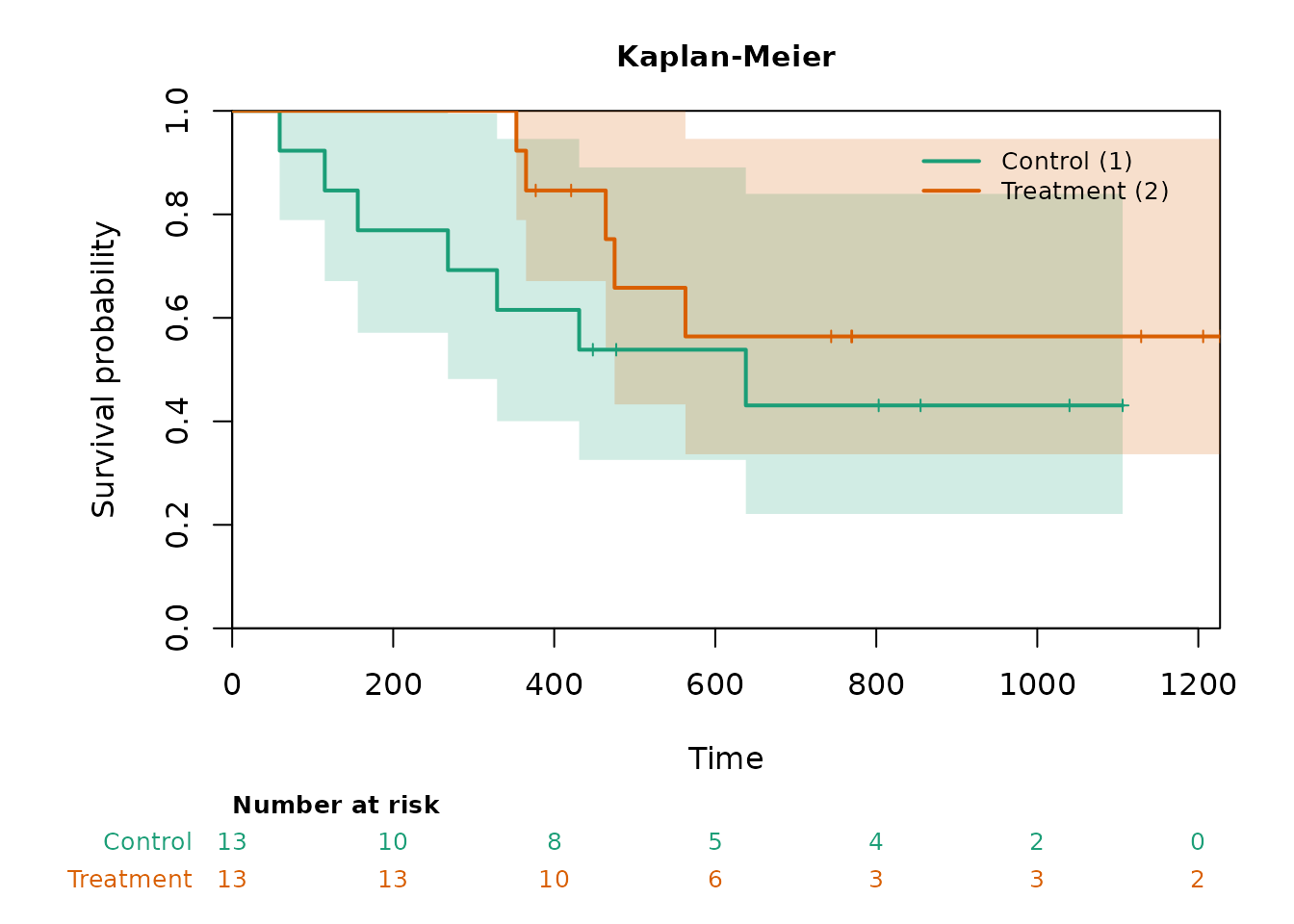
Where to go next
Several further vignettes cover the package in depth. Validation
of FastSurvival checks numerical agreement with established
packages on a real clinical-trial dataset. Speed comparison
quantifies the performance gain. Group sequential design with the
simulation trio demonstrates simdata_fast(),
analysis_fast(), and simsummary_fast() against
a gsDesign reference. Further applied vignettes work the simulation
functions through nonproportional-hazards, correlated multiple-endpoint,
multi-arm, multiregional, and treatment-switching settings, and
Using your own data generator analyzes data generated outside
the package with the same functions.