
Survival Endpoints: Hazard Ratio, Milestone Survival, and RMST
Source:vignettes/survival-endpoints.Rmd
survival-endpoints.RmdThis vignette describes Regional Consistency Probability (RCP) calculations for three survival endpoint types: hazard ratio, milestone survival probability, and restricted mean survival time (RMST). All three endpoints share a common trial design framework, and event times are modelled by the exponential distribution.
Common trial design framework
For all survival endpoints, the following parameters define the trial design.
| Parameter | Symbol | Description |
|---|---|---|
t_a |
Accrual period; patients enrol uniformly over | |
t_f |
Follow-up period after accrual closes | |
tau |
Total study duration (computed internally) | |
lambda |
True hazard rate under the alternative (exponential model) | |
lambda0 |
Historical control hazard rate | |
lambda_dropout |
Dropout hazard rate; NULL assumes no dropout
(default) |
The common parameters below are used throughout the examples in this vignette.
lambda  <- log(2) / 10   # treatment arm: median survival = 10
lambda0 <- log(2) / 5    # historical control: median survival = 5
t_a     <- 3             # accrual period
t_f     <- 10            # follow-up period
# True HR = lambda / lambda0 = 0.5
1. Hazard Ratio Endpoint
Statistical model
Under the exponential model with uniform accrual over and administrative censoring at , the expected event probability per patient is:
The expected number of events in Region is , and the log-hazard ratio estimator has the approximate distribution:
Consistency criteria
Method 1 (log-HR scale):
Letting , , and :
Method 1 (linear-HR scale) (Hayashi and Itoh 2018):
This is derived via the delta method. Define . Under homogeneity:
and .
Method 2:
Example
result_f <- rcp1armHazardRatio(
  lambda         = lambda,
  lambda0        = lambda0,
  Nj             = c(20, 80),
  t_a            = t_a,
  t_f            = t_f,
  lambda_dropout = NULL,
  PI             = 0.5,
  approach       = "formula"
)
print(result_f)
#>
#> Regional Consistency Probability for Single-Arm MRCT
#> Endpoint : Time-to-Event (Hazard Ratio)
#>
#>    Approach       : Closed-Form Solution
#>    True Hazard    : lambda  = 0.069315
#>    Control Hazard : lambda0 = 0.138629
#>    Sample Size    : Nj      = (20, 80)
#>    Total Size     : N       = 100
#>    Accrual Period : t_a     = 3.00
#>    Follow-up      : t_f     = 10.00
#>    Study Duration : tau     = 13.00
#>    Dropout Hazard : lambda_d = NA
#>    Threshold      : PI      = 0.5000
#>
#> Consistency Probabilities:
#>    Method 1 (Region 1 vs Overall):
#>       Log-HR based    : 0.8935
#>       Linear-HR based : 0.9228
#>    Method 2 (All Regions Show Benefit):
#>       HR < 1          : 0.9892
result_s <- rcp1armHazardRatio(
  lambda         = lambda,
  lambda0        = lambda0,
  Nj             = c(20, 80),
  t_a            = t_a,
  t_f            = t_f,
  lambda_dropout = NULL,
  PI             = 0.5,
  approach       = "simulation",
  nsim           = 10000,
  seed           = 1
)
print(result_s)
#>
#> Regional Consistency Probability for Single-Arm MRCT
#> Endpoint : Time-to-Event (Hazard Ratio)
#>
#>    Approach       : Simulation-Based (nsim = 10000)
#>    True Hazard    : lambda  = 0.069315
#>    Control Hazard : lambda0 = 0.138629
#>    Sample Size    : Nj      = (20, 80)
#>    Total Size     : N       = 100
#>    Accrual Period : t_a     = 3.00
#>    Follow-up      : t_f     = 10.00
#>    Study Duration : tau     = 13.00
#>    Dropout Hazard : lambda_d = NA
#>    Threshold      : PI      = 0.5000
#>
#> Consistency Probabilities:
#>    Method 1 (Region 1 vs Overall):
#>       Log-HR based    : 0.9019
#>       Linear-HR based : 0.9320
#>    Method 2 (All Regions Show Benefit):
#>       HR < 1          : 0.9924
Effect of dropout
Specifying lambda_dropout reduces the expected event
probability
,
which in turn reduces all RCP values.
result_dropout <- rcp1armHazardRatio(
  lambda         = lambda,
  lambda0        = lambda0,
  Nj             = c(20, 80),
  t_a            = t_a,
  t_f            = t_f,
  lambda_dropout = 0.05,
  PI             = 0.5,
  approach       = "formula"
)
print(result_dropout)
#>
#> Regional Consistency Probability for Single-Arm MRCT
#> Endpoint : Time-to-Event (Hazard Ratio)
#>
#>    Approach       : Closed-Form Solution
#>    True Hazard    : lambda  = 0.069315
#>    Control Hazard : lambda0 = 0.138629
#>    Sample Size    : Nj      = (20, 80)
#>    Total Size     : N       = 100
#>    Accrual Period : t_a     = 3.00
#>    Follow-up      : t_f     = 10.00
#>    Study Duration : tau     = 13.00
#>    Dropout Hazard : lambda_d = 0.050000
#>    Threshold      : PI      = 0.5000
#>
#> Consistency Probabilities:
#>    Method 1 (Region 1 vs Overall):
#>       Log-HR based    : 0.8656
#>       Linear-HR based : 0.8971
#>    Method 2 (All Regions Show Benefit):
#>       HR < 1          : 0.9793
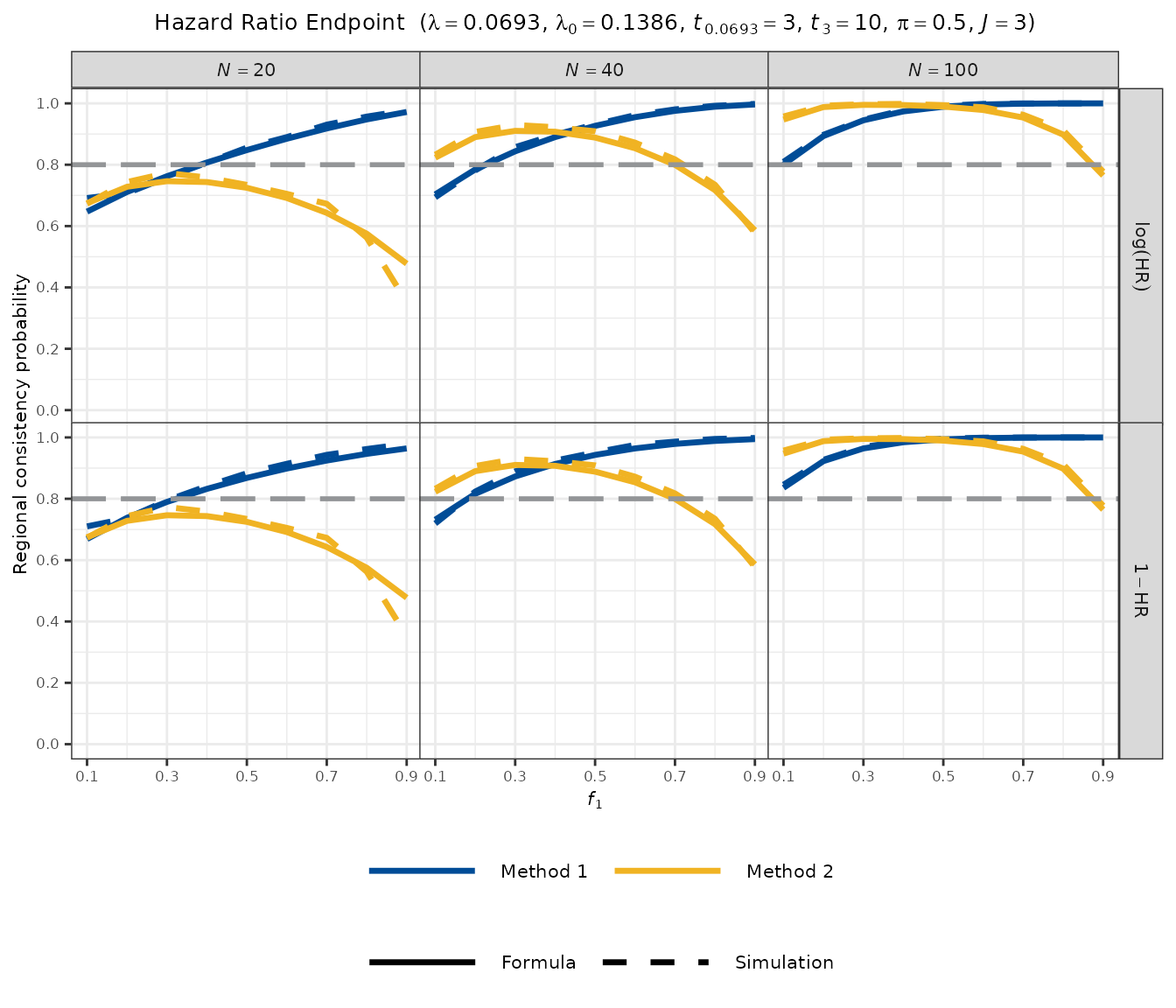
Visualisation
plot_rcp1armHazardRatio(
  lambda    = lambda,
  lambda0   = lambda0,
  t_a       = t_a,
  t_f       = t_f,
  PI        = 0.5,
  N_vec     = c(20, 40, 100),
  J         = 3,
  nsim      = 5000,
  seed      = 1,
  base_size = 8
)
2. Milestone Survival Endpoint
Statistical model
The treatment effect at evaluation time is:
where is the historical control survival rate at , supplied by the user.
The asymptotic variance of the Kaplan-Meier estimator is derived from Greenwood’s formula:
where:
Closed-form solution when ( throughout):
For
this reduces to the binomial variance
.
When
,
the integral is evaluated numerically via
stats::integrate().
Example
t_eval <- 8
S0     <- exp(-log(2) * t_eval / 5)
cat(sprintf("True S(%g) = %.4f,  S0 = %.4f,  delta = %.4f\n",
            t_eval, exp(-lambda * t_eval), S0,
            exp(-lambda * t_eval) - S0))
#> True S(8) = 0.5743,  S0 = 0.3299,  delta = 0.2445
result_f <- rcp1armMilestoneSurvival(
  lambda         = lambda,
  t_eval         = t_eval,
  S0             = S0,
  Nj             = c(20, 80),
  t_a            = t_a,
  t_f            = t_f,
  lambda_dropout = NULL,
  PI             = 0.5,
  approach       = "formula"
)
print(result_f)
#>
#> Regional Consistency Probability for Single-Arm MRCT
#> Endpoint : Milestone Survival
#>
#>    Approach       : Closed-Form Solution (Greenwood)
#>    True Hazard    : lambda  = 0.069315
#>    Sample Size    : Nj      = (20, 80)
#>    Total Size     : N       = 100
#>    Accrual Period : t_a     = 3.00
#>    Follow-up      : t_f     = 10.00
#>    Study Duration : tau     = 13.00
#>    Dropout Hazard : lambda_d = NA
#>    Threshold      : PI      = 0.5000
#>    Eval Time      : t_eval  = 8.00
#>    Control Surv   : S0      = 0.3299
#>    True Surv      : S_est   = 0.5743
#>
#> Consistency Probabilities:
#>    Method 1 (Region 1 vs Overall)  : 0.8848
#>    Method 2 (All Regions > S0)     : 0.9865
Since
,
the closed-form solution is used
(formula_type = "closed-form"). For
,
numerical integration is applied automatically.
result_s <- rcp1armMilestoneSurvival(
  lambda         = lambda,
  t_eval         = t_eval,
  S0             = S0,
  Nj             = c(20, 80),
  t_a            = t_a,
  t_f            = t_f,
  lambda_dropout = NULL,
  PI             = 0.5,
  approach       = "simulation",
  nsim           = 10000,
  seed           = 1
)
print(result_s)
#>
#> Regional Consistency Probability for Single-Arm MRCT
#> Endpoint : Milestone Survival
#>
#>    Approach       : Simulation-Based (nsim = 10000)
#>    True Hazard    : lambda  = 0.069315
#>    Sample Size    : Nj      = (20, 80)
#>    Total Size     : N       = 100
#>    Accrual Period : t_a     = 3.00
#>    Follow-up      : t_f     = 10.00
#>    Study Duration : tau     = 13.00
#>    Dropout Hazard : lambda_d = NA
#>    Threshold      : PI      = 0.5000
#>    Eval Time      : t_eval  = 8.00
#>    Control Surv   : S0      = 0.3299
#>    True Surv      : S_est   = 0.5743
#>
#> Consistency Probabilities:
#>    Method 1 (Region 1 vs Overall)  : 0.8873
#>    Method 2 (All Regions > S0)     : 0.9887
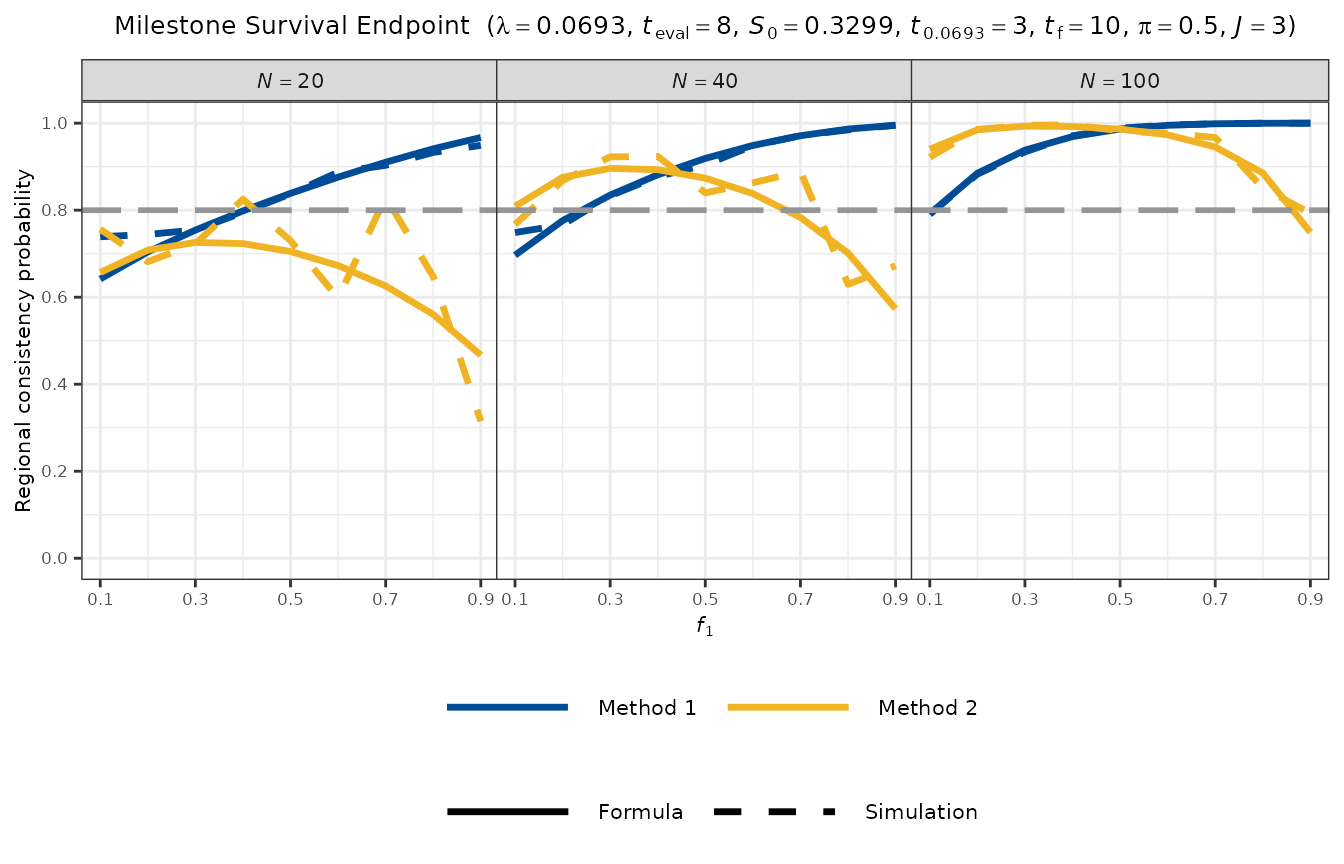
Visualisation
plot_rcp1armMilestoneSurvival(
  lambda    = lambda,
  t_eval    = t_eval,
  S0        = S0,
  t_a       = t_a,
  t_f       = t_f,
  PI        = 0.5,
  N_vec     = c(20, 40, 100),
  J         = 3,
  nsim      = 5000,
  seed      = 1,
  base_size = 8
)
3. RMST Endpoint
Statistical model
The restricted mean survival time (RMST) up to truncation time is:
The asymptotic variance of the regional RMST estimator is:
where:
Closed-form solution when , using (and ):
$$ v_{\text{RMST}}(\tau^*) = \frac{1}{\lambda}\Bigl[ A(\lambda_d) - 2\,e^{-\lambda\tau^*}\,A(\lambda_d + \lambda) + e^{-2\lambda\tau^*}\,A(\lambda_d + 2\lambda) \Bigr] $$
For this simplifies to:
When
,
the integral is split at
and evaluated via stats::integrate().
Example
tau_star <- 8
mu0      <- (1 - exp(-lambda0 * tau_star)) / lambda0
mu_est   <- (1 - exp(-lambda  * tau_star)) / lambda
cat(sprintf("True RMST = %.4f,  mu0 = %.4f,  delta = %.4f\n",
            mu_est, mu0, mu_est - mu0))
#> True RMST = 6.1408,  mu0 = 4.8339,  delta = 1.3069
result_f <- rcp1armRMST(
  lambda         = lambda,
  tau_star       = tau_star,
  mu0            = mu0,
  Nj             = c(20, 80),
  t_a            = t_a,
  t_f            = t_f,
  lambda_dropout = NULL,
  PI             = 0.5,
  approach       = "formula"
)
print(result_f)
#>
#> Regional Consistency Probability for Single-Arm MRCT
#> Endpoint : Restricted Mean Survival Time (RMST)
#>
#>    Approach       : Closed-Form Solution
#>    True Hazard    : lambda  = 0.069315
#>    Sample Size    : Nj      = (20, 80)
#>    Total Size     : N       = 100
#>    Accrual Period : t_a     = 3.00
#>    Follow-up      : t_f     = 10.00
#>    Study Duration : tau     = 13.00
#>    Dropout Hazard : lambda_d = NA
#>    Threshold      : PI      = 0.5000
#>    Trunc. Time    : tau*    = 8.00
#>    Control RMST   : mu0     = 4.8339
#>    True RMST      : mu_est  = 6.1408
#>
#> Consistency Probabilities:
#>    Method 1 (Region 1 vs Overall)  : 0.8693
#>    Method 2 (All Regions > mu0)    : 0.9808
result_s <- rcp1armRMST(
  lambda         = lambda,
  tau_star       = tau_star,
  mu0            = mu0,
  Nj             = c(20, 80),
  t_a            = t_a,
  t_f            = t_f,
  lambda_dropout = NULL,
  PI             = 0.5,
  approach       = "simulation",
  nsim           = 10000,
  seed           = 1
)
print(result_s)
#>
#> Regional Consistency Probability for Single-Arm MRCT
#> Endpoint : Restricted Mean Survival Time (RMST)
#>
#>    Approach       : Simulation-Based (nsim = 10000)
#>    True Hazard    : lambda  = 0.069315
#>    Sample Size    : Nj      = (20, 80)
#>    Total Size     : N       = 100
#>    Accrual Period : t_a     = 3.00
#>    Follow-up      : t_f     = 10.00
#>    Study Duration : tau     = 13.00
#>    Dropout Hazard : lambda_d = NA
#>    Threshold      : PI      = 0.5000
#>    Trunc. Time    : tau*    = 8.00
#>    Control RMST   : mu0     = 4.8339
#>    True RMST      : mu_est  = 6.1408
#>
#> Consistency Probabilities:
#>    Method 1 (Region 1 vs Overall)  : 0.8790
#>    Method 2 (All Regions > mu0)    : 0.9809
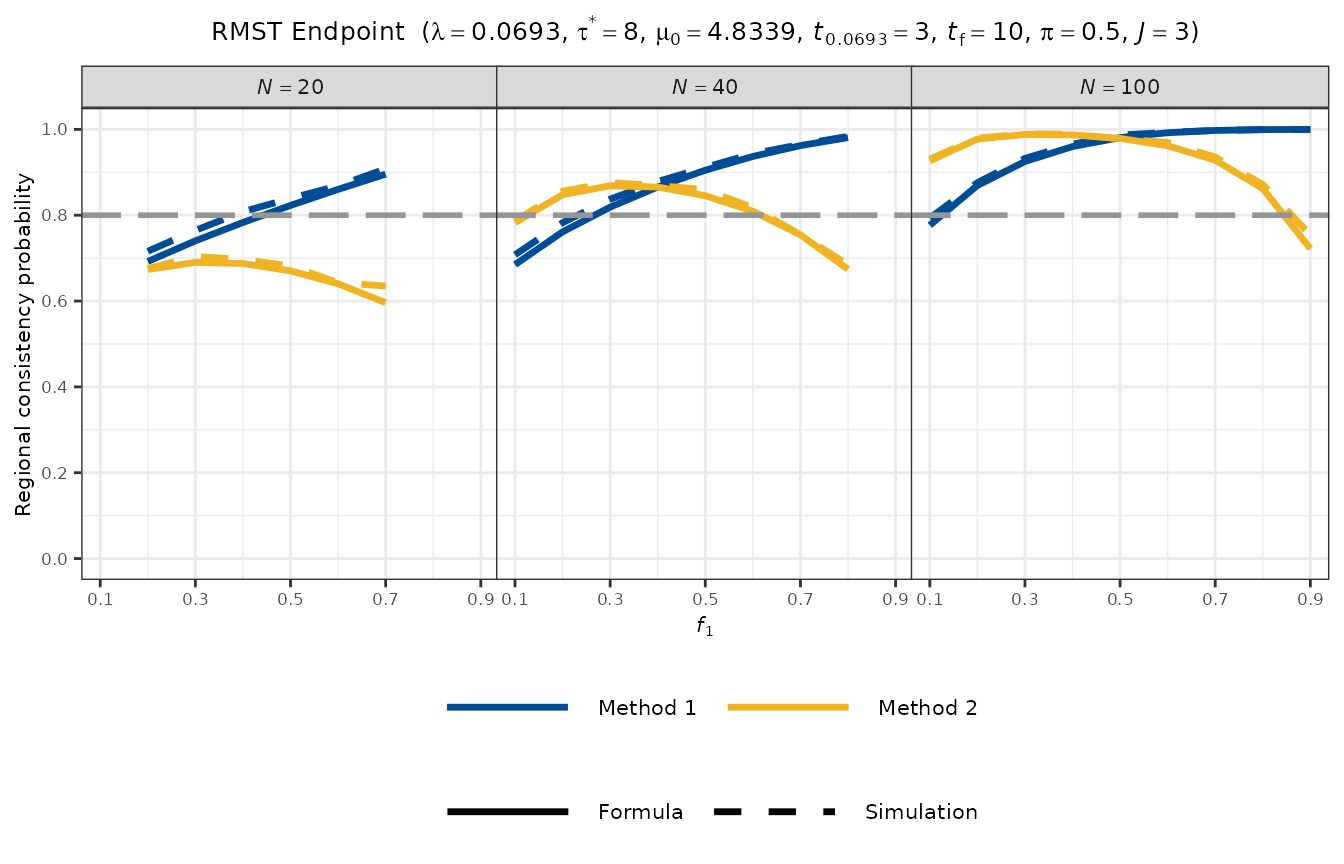
Visualisation
plot_rcp1armRMST(
  lambda    = lambda,
  tau_star  = tau_star,
  mu0       = mu0,
  t_a       = t_a,
  t_f       = t_f,
  PI        = 0.5,
  N_vec     = c(20, 40, 100),
  J         = 3,
  nsim      = 5000,
  seed      = 1,
  base_size = 8
)
Summary
| Endpoint | Effect parameter | Benefit direction | Variance basis | Closed-form condition |
|---|---|---|---|---|
| Hazard Ratio | (Method 1, log-HR scale); (Method 1, linear-HR scale) | Expected events via (Wu 2015) | Always | |
| Milestone Survival | Greenwood’s formula | |||
| RMST | Squared survival difference integral |
References
Hayashi N, Itoh Y (2017). A re-examination of Japanese sample size calculation for multi-regional clinical trial evaluating survival endpoint. Japanese Journal of Biometrics, 38(2): 79–92. https://doi.org/10.5691/jjb.38.79
Wu J (2015). Sample size calculation for the one-sample log-rank test. Pharmaceutical Statistics, 14(1): 26–33. https://doi.org/10.1002/pst.1654