Decisions in a proof-of-concept study
BayesianQDM implements the Bayesian quantitative decision-making framework of Kang, Yamaguchi and Han (2026) for proof-of-concept (PoC) studies. The data of a PoC study lead to one of three decisions: Go (proceed to the next phase of development), NoGo (stop the development) or Gray (the evidence is not sufficient for either decision).
Let be the treatment effect, the difference between the treatment and control groups in the response rate (binary endpoint), the mean (continuous endpoint) or the survival probability at a milestone time (time-to-event endpoint), or the ratio of the hazards of the two groups (time-to-event endpoint). The decision criteria use two values of the effect chosen by the study team: the target value , an effect worth pursuing, and the minimum acceptable value , below which the treatment is not of interest. Given the PoC data , the criteria based on the posterior probability are
- Go criterion: ,
- NoGo criterion: .
The decision is Go if only the Go criterion is met, NoGo if only the NoGo criterion is met, and Gray if neither is met. If both are met, which for one endpoint is possible only when , the decision is called Miss; the package reports Miss decisions separately and warns when they have positive probability.
Kang et al. (2026) write the NoGo criterion as
.
This is the same criterion with
,
so a threshold
of the article corresponds to gamma_nogo = 0.8.
When smaller effects are favorable, as for the rate of an adverse
event or a hazard ratio, direction = "less" in the
criterion reverses the inequalities: the Go criterion is
and the NoGo criterion is
,
with
(see vignette("single-binary") and
vignette("time-to-event")).
The criteria can instead be based on the posterior predictive probability of the effect that will be observed in a future study with and subjects. With a null value , the Go criterion is and the NoGo criterion is .
For two endpoints, the target values and minimum acceptable values
divide the plane of
into nine regions, and the criteria are based on the probabilities of
unions of regions or on each endpoint separately (see
vignette("two-binary") and
vignette("two-continuous")).
Specifying a study
A study is described by small specification objects, which are combined into a design.
| Function | Specifies |
|---|---|
prior_beta(), prior_nix(),
prior_dirichlet(), prior_niw(),
prior_gamma(), prior_vague()
|
Prior distribution of one group |
data_binary(), data_continuous(),
data_binary2(), data_continuous2(),
data_tte()
|
Summary of the data of one group |
borrow() |
External data and the weight of the power prior |
hypothetical() |
Hypothetical control for a study without a concurrent control group |
criterion_posterior(),
criterion_predictive()
|
Decision criterion |
conduct_tte() |
Enrollment, dropout and time of the analysis of a study with a time-to-event endpoint |
design_binary(), design_continuous(),
design_binary2(), design_continuous2(),
design_tte()
|
Design of the study |
The control group of a design takes one of four forms: a concurrent
control group (n_c of at least 1 for binary and
time-to-event endpoints, 2 for one continuous endpoint and 3 for two
continuous endpoints), external control data only (n_c = 0
and external_c), a hypothetical control
(n_c = 0 and hypothetical_c), or a fixed
control (n_c = 0 and fixed_c), a known value
of the control parameter as in a single-arm study compared with a
benchmark. External data can also be borrowed for the treatment group
(external_t).
Four functions work with the designs.
| Function | Computes |
|---|---|
qdm_decide() |
The probabilities of the Go and NoGo regions and the decision for observed data |
qdm_oc() |
The operating characteristics: the probabilities of Go, NoGo, Gray and Miss decisions under scenarios for the true parameters |
qdm_calibrate() |
The thresholds and that control the probabilities of a false Go and a false NoGo decision |
qdm_boundary() |
The observed data that lead to each decision, for example the numbers of responders, with the observed rates and effects (not available for two binary endpoints) |
A first example
Consider a PoC study with one binary endpoint, 12 subjects in each group and Jeffreys priors . The team chooses , , and .
des <- design_binary(
  n_t = 12, n_c = 12,
  prior_t = prior_beta(0.5, 0.5), prior_c = prior_beta(0.5, 0.5),
  criterion = criterion_posterior(theta_tv = 0.2, theta_mav = 0.1,
                                  gamma_go = 0.5, gamma_nogo = 0.8)
)
des
#> Design: one binary endpoint
#>   Treatment: n = 12, prior Beta(a = 0.5, b = 0.5)
#>   Control: concurrent, n = 12, prior Beta(a = 0.5, b = 0.5)
#> Posterior probability criterion
#>   Go:   P(theta > 0.2 | data) >= 0.5
#>   NoGo: P(theta <= 0.1 | data) >= 0.8
If 9 of 12 subjects respond in the treatment group and 4 of 12 in the control group, the decision is:
dec <- qdm_decide(des, data_t = data_binary(12, 9),
                  data_c = data_binary(12, 4))
dec
#> Decision: Go
#>   Go:   P(theta > 0.2 | data) = 0.8517 (threshold 0.5, met)
#>   NoGo: P(theta <= 0.1 | data) = 0.05935 (threshold 0.8, not met)
#> Posterior distributions
#>   Treatment: Beta(a = 9.5, b = 3.5)
#>   Control:   Beta(a = 4.5, b = 8.5)
The posterior probability that the effect exceeds the target value is 0.852, and the decision is Go.
The operating characteristics show how often the design leads to each decision. For a binary endpoint all outcomes of the study are enumerated, so the probabilities are exact.
oc <- qdm_oc(des, data.frame(pi_t = seq(0.3, 0.7, by = 0.05), pi_c = 0.3))
oc
#> Operating characteristics (exact enumeration of the outcomes)
#>  pi_t pi_c     Go    NoGo   Gray Miss
#>  0.30  0.3 0.1316 0.41696 0.4514    0
#>  0.35  0.3 0.2032 0.31739 0.4794    0
#>  0.40  0.3 0.2893 0.23249 0.4782    0
#>  0.45  0.3 0.3860 0.16327 0.4507    0
#>  0.50  0.3 0.4883 0.10937 0.4023    0
#>  0.55  0.3 0.5906 0.06942 0.3399    0
#>  0.60  0.3 0.6875 0.04137 0.2711    0
#>  0.65  0.3 0.7742 0.02286 0.2030    0
#>  0.70  0.3 0.8472 0.01150 0.1413    0
plot(oc)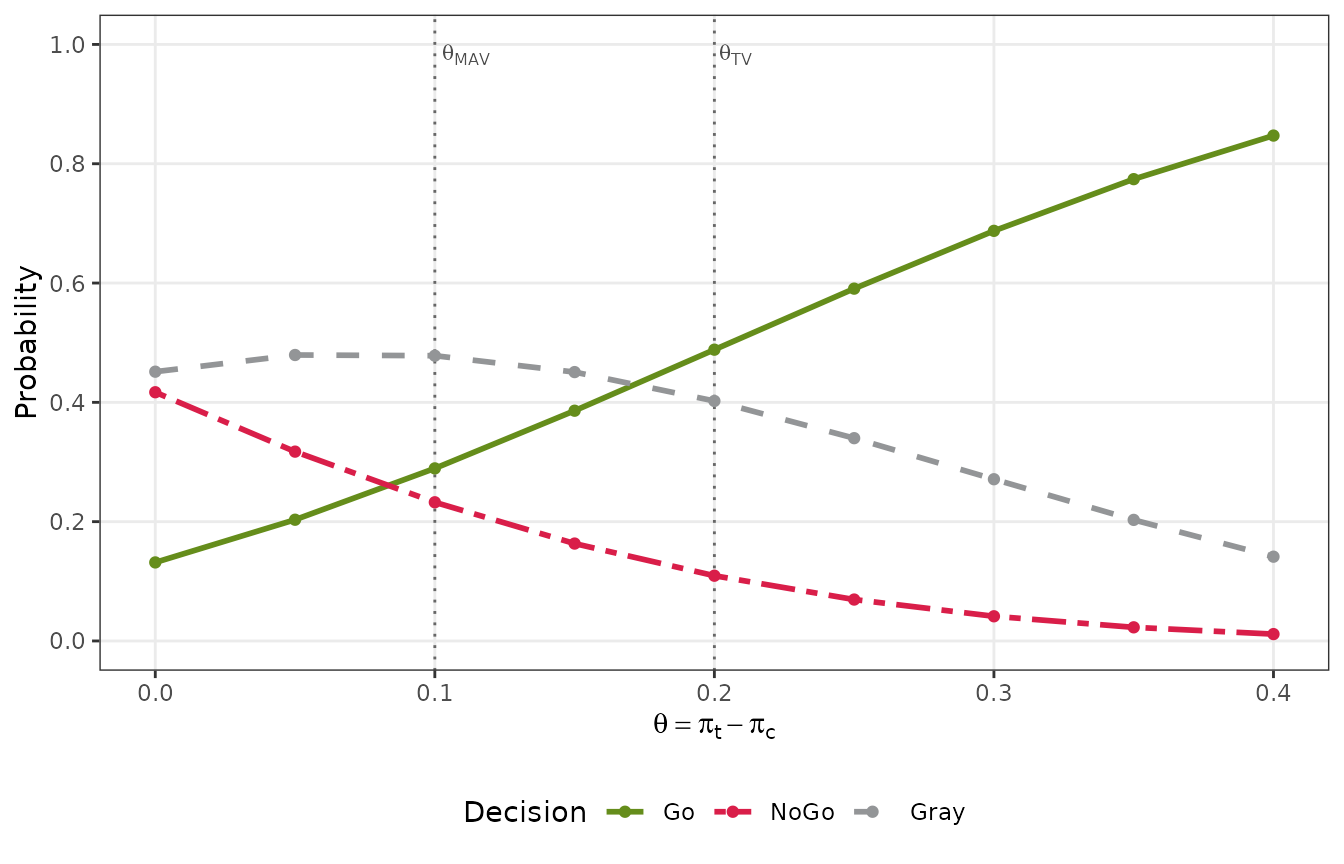
When the treatment has no effect (), the probability of a Go decision is 0.132. The thresholds can be calibrated so that the probability of meeting the Go criterion is at most 0.05 under no effect, and the probability of meeting the NoGo criterion is at most 0.2 when the effect is 0.3:
cal <- qdm_calibrate(des,
                     scenario_go = data.frame(pi_t = 0.3, pi_c = 0.3),
                     scenario_nogo = data.frame(pi_t = 0.6, pi_c = 0.3),
                     target_go = 0.05, target_nogo = 0.2)
cal
#> Calibration of the decision thresholds (exact enumeration of the outcomes)
#>   gamma_go   = 0.74: P(Go criterion met | scenario_go) = 0.03587 (target 0.05)
#>   gamma_nogo = 0.39: P(NoGo criterion met | scenario_nogo) = 0.182 (target 0.2)
#> Decision probabilities with the chosen thresholds
#>       scenario pi_t pi_c      Go   NoGo   Gray Miss
#>    scenario_go  0.3  0.3 0.03587 0.7486 0.2155    0
#>  scenario_nogo  0.6  0.3 0.36483 0.1820 0.4531    0
plot(cal)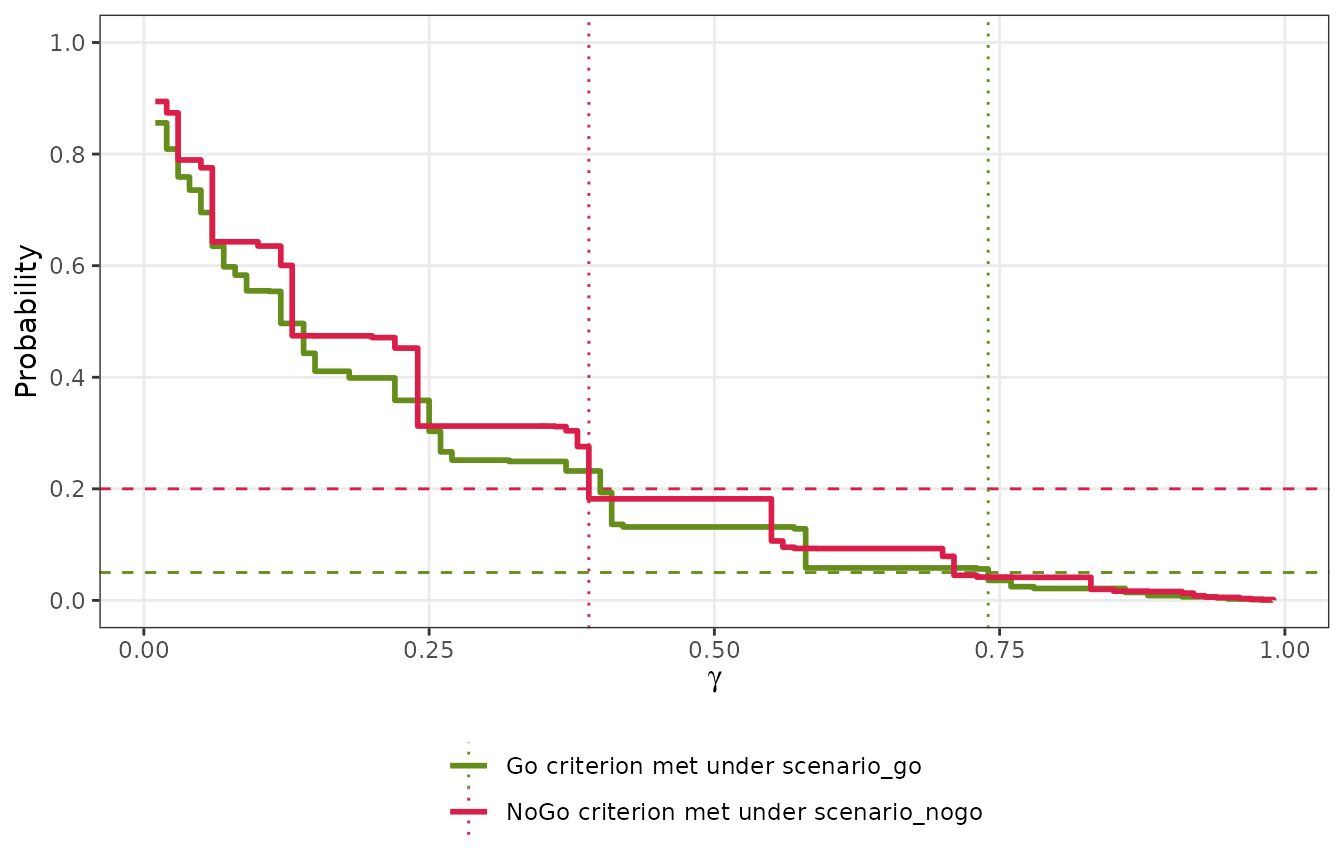
The calibrated thresholds are
0.74 and
0.39, and cal$design is the design with these thresholds,
which can be passed to qdm_decide() and
qdm_oc().
qdm_boundary() shows which observed data lead to each
decision. For each number of control responders, it gives the numbers of
treatment responders that lead to Go, NoGo and Gray decisions, the
corresponding observed response rates of the treatment group and the
observed differences in response rates:
b <- qdm_boundary(des)
b
#> Decision boundary of a design with one binary endpoint
#>   n_t = 12, n_c = 12
#>
#> Responders in the treatment group (y_t)
#>   y_c   NoGo   Gray    Go
#>   0     0      1-2     3-12
#>   1     0-1    2-3     4-12
#>   2     0-1    2-4     5-12
#>   3     0-2    3-5     6-12
#>   4     0-3    4-6     7-12
#>   5     0-4    5-7     8-12
#>   6     0-5    6-8     9-12
#>   7     0-6    7-9     10-12
#>   8     0-7    8-10    11-12
#>   9     0-8    9-11    12
#>   10    0-9    10-12   -
#>   11    0-11   12      -
#>   12    0-12   -       -
#>
#> Observed response rate (y_t / n_t)
#>   y_c   NoGo             Gray              Go
#>   0     0.0%             8.3% to 16.7%     25.0% to 100.0%
#>   1     0.0% to 8.3%     16.7% to 25.0%    33.3% to 100.0%
#>   2     0.0% to 8.3%     16.7% to 33.3%    41.7% to 100.0%
#>   3     0.0% to 16.7%    25.0% to 41.7%    50.0% to 100.0%
#>   4     0.0% to 25.0%    33.3% to 50.0%    58.3% to 100.0%
#>   5     0.0% to 33.3%    41.7% to 58.3%    66.7% to 100.0%
#>   6     0.0% to 41.7%    50.0% to 66.7%    75.0% to 100.0%
#>   7     0.0% to 50.0%    58.3% to 75.0%    83.3% to 100.0%
#>   8     0.0% to 58.3%    66.7% to 83.3%    91.7% to 100.0%
#>   9     0.0% to 66.7%    75.0% to 91.7%    100.0%
#>   10    0.0% to 75.0%    83.3% to 100.0%   -
#>   11    0.0% to 91.7%    100.0%            -
#>   12    0.0% to 100.0%   -                 -
#>
#> Observed difference in response rates (y_t / n_t - y_c / n_c)
#>   y_c   NoGo                  Gray                Go
#>   0     0                     0.08333 to 0.1667   0.25 to 1
#>   1     -0.08333 to 0         0.08333 to 0.1667   0.25 to 0.9167
#>   2     -0.1667 to -0.08333   0 to 0.1667         0.25 to 0.8333
#>   3     -0.25 to -0.08333     0 to 0.1667         0.25 to 0.75
#>   4     -0.3333 to -0.08333   0 to 0.1667         0.25 to 0.6667
#>   5     -0.4167 to -0.08333   0 to 0.1667         0.25 to 0.5833
#>   6     -0.5 to -0.08333      0 to 0.1667         0.25 to 0.5
#>   7     -0.5833 to -0.08333   0 to 0.1667         0.25 to 0.4167
#>   8     -0.6667 to -0.08333   0 to 0.1667         0.25 to 0.3333
#>   9     -0.75 to -0.08333     0 to 0.1667         0.25
#>   10    -0.8333 to -0.08333   0 to 0.1667         -
#>   11    -0.9167 to 0          0.08333             -
#>   12    -1 to 0               -                   -
plot(b)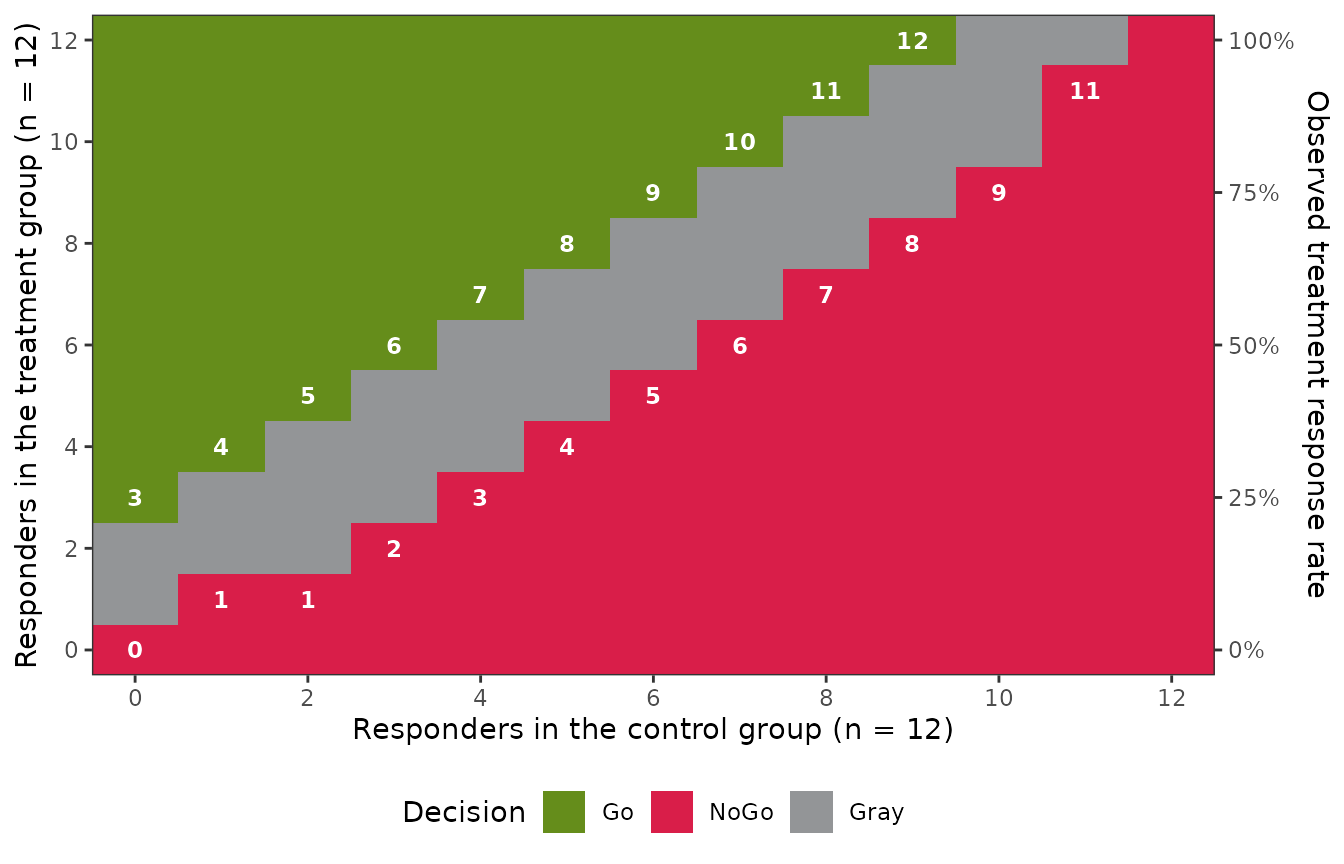
With 4 control responders, a Go decision needs at least 7 of the 12 treatment subjects to respond.
Plots
The plot() methods return ggplot2 objects. Depending on
the plot, their arguments set the colors of the decisions
(col_go, col_nogo, col_gray and
col_miss), the width of the lines (linewidth),
the size of the points (point_size), the size of the text
drawn in the plot (label_size), the base font size
(base_size) and the position of the legend
(legend_position); the help pages of
plot.qdm_oc(), plot.qdm_calibration() and
plot.qdm_boundary() list them. Anything else can be changed
by adding ggplot2 functions, as for any other ggplot2 plot:
plot(oc, col_go = "darkgreen", col_nogo = "firebrick", linewidth = 0.7,
     base_size = 13, legend_position = "right") +
  ggplot2::labs(title = "Operating characteristics of the design")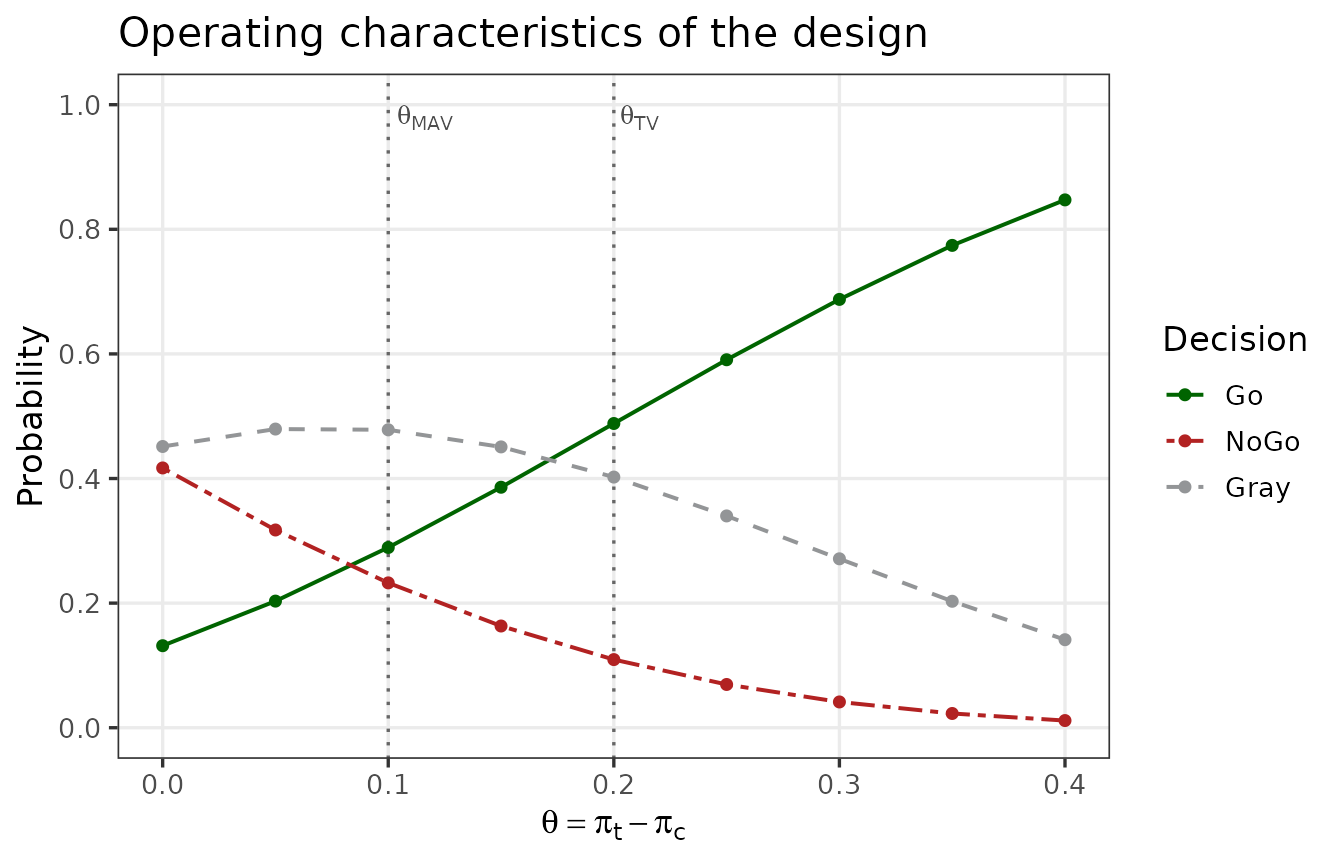
Endpoints and computation
| Endpoints | Design | Model | Probabilities of the regions | Operating characteristics |
|---|---|---|---|---|
| One binary | design_binary() |
Beta-binomial | Numerical integration (posterior), exact sum (predictive) | Exact enumeration |
| One continuous | design_continuous() |
Normal-Inverse-chi-squared or vague | Numerical integration ("NI"), moment matching
("MM") or Monte Carlo ("MC") |
Simulation of nsim studies |
| Two binary | design_binary2() |
Dirichlet-multinomial | Monte Carlo with nMC draws (posterior), exact sum
(predictive) |
Exact enumeration or simulation |
| Two continuous | design_continuous2() |
Normal-Inverse-Wishart or vague | Moment matching ("MM") or Monte Carlo
("MC") |
Simulation of nsim studies |
| One time-to-event | design_tte() |
Exponential with Gamma prior (milestone survival or hazard ratio) | Numerical integration or F distribution (posterior), simulation of
nMC future studies (predictive) |
Simulation of nsim studies |
The posterior distributions have closed forms, including those with
external data borrowed through a power prior, so Markov chain Monte
Carlo sampling is not needed. With a fixed control, the probabilities
depend only on the posterior distribution of the treatment group and are
computed from closed forms or by numerical integration, except for the
posterior probabilities of two binary endpoints and the predictive
probabilities of a time-to-event endpoint, which are Monte Carlo
estimates. For one continuous endpoint, numerical integration is exact
up to a small numerical error; the moment-matching approximation is
faster by about two orders of magnitude and is suited to exploring
designs, and the chosen design can then be checked with numerical
integration. For two continuous endpoints, the moment-matching
approximation can be checked with Monte Carlo estimates. The computing
time of Monte Carlo estimates is proportional to the number of draws,
and that of simulated operating characteristics to
nsim.
Random numbers
qdm_decide(), qdm_oc(),
qdm_calibrate() and qdm_boundary() have a
seed argument for the random numbers they use (simulated
studies and Monte Carlo estimates of probabilities). With
seed = NULL (the default) they use the current random
number stream, so set.seed() makes the results
reproducible. With a given seed, the computation uses that seed and the
previous state of the random number generator is restored on exit.
ptdiff() with method = "MC" and
rdirichlet() always use the current random number
stream.
Validation
The scripts in the folder validation of the installed
package compare BayesianQDM with published and submitted results (Kang
et al., 2026; Huang, Talukder, Han and Kuan, 2019; Huang et al.,
submitted; Yamaguchi, Homma, Takeda and Maruo, submitted; Yamaguchi et
al., submitted). The file results/summary.md in that folder
reports the comparisons, with a registered reason for every difference
beyond rounding:
system.file("validation", "results", "summary.md", package = "BayesianQDM")Further reading
-
vignette("single-binary"): one binary endpoint. -
vignette("single-continuous"): one continuous endpoint. -
vignette("two-binary"): two binary endpoints. -
vignette("two-continuous"): two continuous endpoints. -
vignette("time-to-event"): one time-to-event endpoint. -
vignette("migration"): translating code written for version 0.1.0.
References
Huang, B., Talukder, E., Han, L. and Kuan, P.-F. (2019). Quantitative decision-making in randomized Phase II studies with a time-to-event endpoint. Journal of Biopharmaceutical Statistics, 29(1), 189–202. https://doi.org/10.1080/10543406.2018.1489400
Huang, Y., Yamaguchi, Y., Homma, G., Takeda, K. and Maruo, K. (submitted). Conjugate representation of power priors for efficient Bayesian analysis of normal data.
Kang, R., Yamaguchi, Y. and Han, C. (2026). Bayesian quantitative decision-making framework in cell and gene therapy development for rare diseases. Journal of Biopharmaceutical Statistics. https://doi.org/10.1080/10543406.2026.2655410
Yamaguchi, Y., Homma, G., Takeda, K. and Maruo, K. (submitted). Moment-matching approximation for t-differences in clinical trials with continuous endpoints.
Yamaguchi, Y., Hu, H., Huang, Y., Han, C., Homma, G. and Wang, A. (submitted). Bivariate Bayesian quantitative decision-making for two endpoints in rare disease drug development.