Computes the operating characteristics of several designs under the same scenarios, for example designs with different sample sizes, prior distributions, external data or thresholds, and collects them in one table with a column that names the design.
Arguments
- designs
A list of designs (created by a
design_*()function such asdesign_binary) or design specifications (started byqdm_endpoint), all for the same endpoint. The names of the list name the designs; designs without a name are called"Design 1","Design 2"and so on, by their position.- scenarios
A data frame of scenarios with the columns needed by all the designs (see
qdm_ocandqdm_scenarios). It must not have a column nameddesign.- nsim, seed
As in
qdm_oc.
Value
An object of class c("qdm_comparison", "data.frame"): the
column design (a factor with the names of the designs as levels,
in the order of designs), followed by the columns of the results
of qdm_oc (the scenarios and the probabilities of the
decisions). The attribute designs is the list of the designs
(built from the specifications) and the attribute method the
methods of computation, named by the designs.
Details
Each design is computed by qdm_oc with the same
scenarios, nsim and seed, so the rows of a design
are those of qdm_oc() for that design alone. With a seed, the
simulated studies of all designs start from the same random numbers. The
warnings of qdm_oc() (Miss decisions, scenarios that are not
evaluable) start with the name of the design.
Designs that differ in one part can be made from one design with the
design steps (see qdm_endpoint), which accept a design; for
example, for several sample sizes,
lapply(c(12, 18, 24), function(n) qdm_sample_size(des, n, n)).
See also
Other operations:
qdm_boundary(),
qdm_calibrate(),
qdm_decide(),
qdm_find_n(),
qdm_oc(),
qdm_scenarios()
Examples
des <- design_binary(
n_t = 12, n_c = 12,
prior_t = prior_beta(0.5, 0.5), prior_c = prior_beta(0.5, 0.5),
criterion = criterion_posterior(theta_tv = 0.2, theta_mav = 0.1,
gamma_go = 0.5, gamma_nogo = 0.8)
)
n <- c(12, 18, 24)
designs <- lapply(n, function(k) qdm_sample_size(des, n_t = k, n_c = k))
names(designs) <- paste(n, "per group")
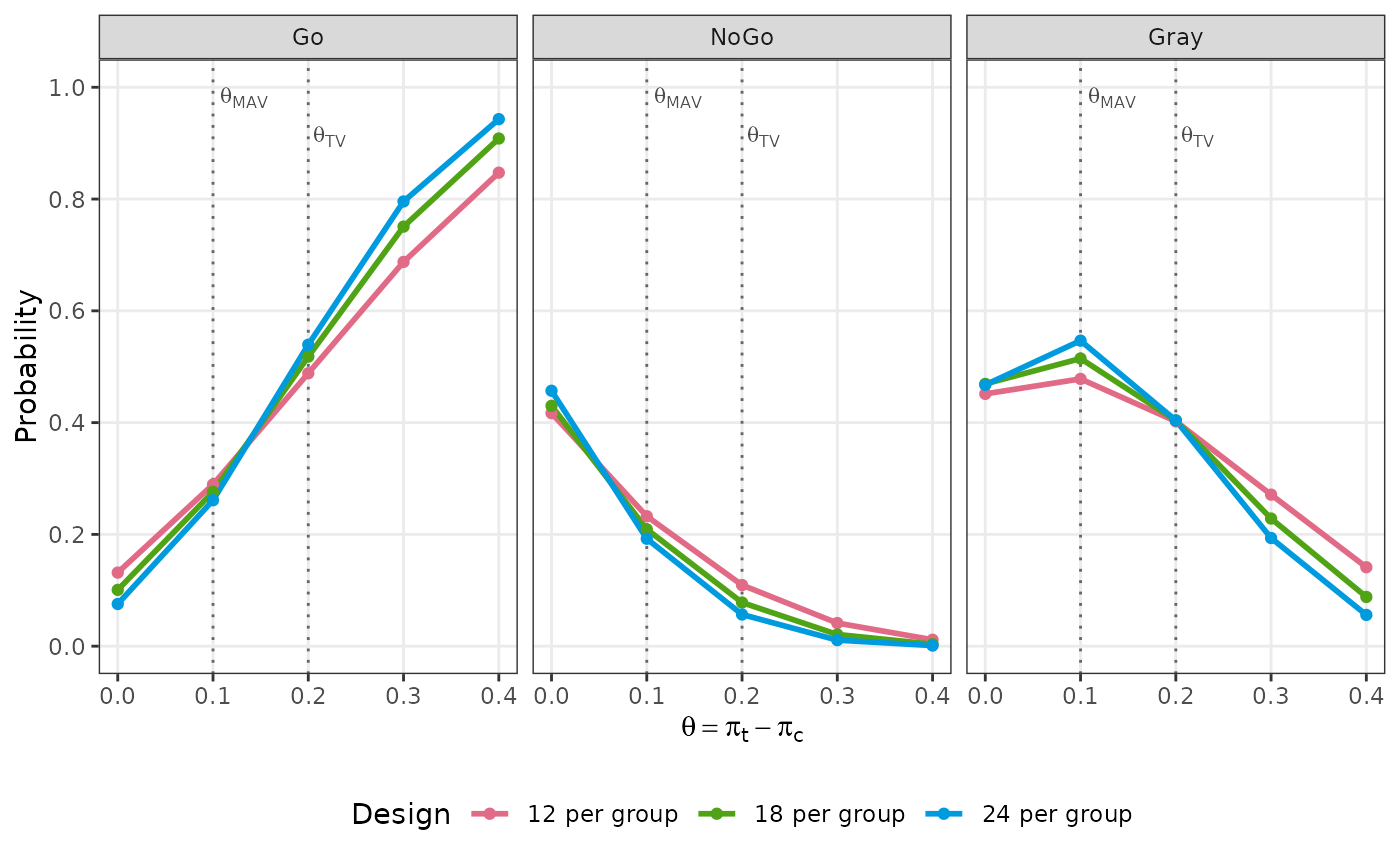
cmp <- qdm_compare(designs, qdm_scenarios(des, theta = seq(0, 0.4, by = 0.1),
pi_c = 0.3))
cmp
#> Operating characteristics of 3 designs
#> Method: exact enumeration of the outcomes
#> design theta pi_t pi_c Go NoGo Gray Miss
#> 12 per group 0.0 0.3 0.3 0.13165 0.416956 0.45139 0
#> 12 per group 0.1 0.4 0.3 0.28929 0.232488 0.47822 0
#> 12 per group 0.2 0.5 0.3 0.48831 0.109372 0.40232 0
#> 12 per group 0.3 0.6 0.3 0.68750 0.041368 0.27113 0
#> 12 per group 0.4 0.7 0.3 0.84722 0.011504 0.14128 0
#> 18 per group 0.0 0.3 0.3 0.10072 0.430011 0.46927 0
#> 18 per group 0.1 0.4 0.3 0.27614 0.209190 0.51467 0
#> 18 per group 0.2 0.5 0.3 0.51809 0.078087 0.40382 0
#> 18 per group 0.3 0.6 0.3 0.75066 0.020935 0.22841 0
#> 18 per group 0.4 0.7 0.3 0.90834 0.003556 0.08811 0
#> 24 per group 0.0 0.3 0.3 0.07551 0.456998 0.46750 0
#> 24 per group 0.1 0.4 0.3 0.26111 0.192246 0.54664 0
#> 24 per group 0.2 0.5 0.3 0.53935 0.056720 0.40393 0
#> 24 per group 0.3 0.6 0.3 0.79565 0.010812 0.19353 0
#> 24 per group 0.4 0.7 0.3 0.94297 0.001128 0.05590 0
plot(cmp)
 # Borrowing of external control data
ext <- qdm_external(des, external_c = borrow(data_binary(40, 12), 0.5))
qdm_compare(list(Concurrent = des, Borrowing = ext),
data.frame(pi_t = c(0.3, 0.6), pi_c = 0.3))
#> Operating characteristics of 2 designs
#> Method: exact enumeration of the outcomes
#> design pi_t pi_c Go NoGo Gray Miss
#> Concurrent 0.3 0.3 0.13165 0.41696 0.4514 0
#> Concurrent 0.6 0.3 0.68750 0.04137 0.2711 0
#> Borrowing 0.3 0.3 0.07869 0.45942 0.4619 0
#> Borrowing 0.6 0.3 0.74445 0.01724 0.2383 0