Finds the smallest sample size, among candidates, for which the
probabilities of a false Go decision and a false NoGo decision are
controlled, with the thresholds of the criterion of the design fixed. It
is the counterpart of qdm_calibrate, which fixes the sample
size and chooses the thresholds.
Usage
qdm_find_n(
  design,
  scenario_go,
  scenario_nogo,
  target_go,
  target_nogo,
  n_t,
  n_c = NULL,
  nsim = 10000L,
  seed = NULL
)
Arguments
- design
A design created by
design_binary,design_continuous,design_binary2,design_continuous2ordesign_tte, or a design specification started byqdm_endpoint. Its sample sizes are replaced by the candidates.- scenario_go, scenario_nogo, target_go, target_nogo
As in
qdm_calibrate.- n_t
Candidate numbers of subjects in the treatment group (distinct whole numbers, in any order; they are sorted).
- n_c
Candidate numbers of subjects in the concurrent control group, one per candidate of
n_tor a single number for all, orNULL(the default) for as many as in the treatment group with a concurrent control group and 0 without one. A ratio of allocation is given byn_c, for examplen_c = n_t / 2for evenn_t.- nsim, seed
As in
qdm_oc.
Value
An object of class "qdm_n_search": a list with elements
- n_t, n_c
The smallest candidate that meets the targets (
NAif none does).- n_t_stable, n_c_stable
The smallest candidate from which every larger candidate also meets the targets (
NAif the largest candidate does not meet them).- prob_go, prob_nogo
The probabilities that the Go criterion is met under
scenario_goand that the NoGo criterion is met underscenario_nogo, forn_tandn_c.- target_go, target_nogo
The targets.
- curve
A data frame with the columns
n_t,n_c,prob_go,prob_nogoandmet(whether both targets are met), one row per candidate.- oc
A data frame of the decision probabilities with
n_tandn_cunder the two scenarios (NULLif no candidate meets the targets).- design
The design with
n_tandn_c(NULLif no candidate meets the targets).- scenario_go, scenario_nogo, method
The scenarios and the method of computation.
Details
For each candidate, the design with the sample sizes n_t[k] and
n_c[k] (set by qdm_sample_size) gives the
probability that the Go criterion is met under scenario_go, a
scenario under which a Go decision would be wrong (typically with no or a
small treatment effect), and the probability that the NoGo criterion is
met under scenario_nogo, a scenario under which a NoGo decision
would be wrong (typically with the expected treatment effect), computed
as in
qdm_calibrate. A candidate meets the targets when the first
probability is at most target_go and the second at most
target_nogo.
The probabilities need not decrease as the sample size increases: for a
binary endpoint they change in steps, so that a larger sample size can
fail the targets that a smaller one meets. The result therefore gives both
the smallest candidate that meets the targets (n_t and n_c)
and the smallest candidate from which every larger candidate also meets
them (n_t_stable and n_c_stable).
With a seed, the simulated studies of all candidates start from the same
random numbers, so the differences between candidates are less affected by
the simulation error than with seed = NULL, under which each
candidate continues the random number stream. For a continuous or
time-to-event endpoint, many candidates and the default nsim can
take long; method = "MM" (continuous endpoints) or a smaller
nsim gives a first answer quickly.
See also
Other operations:
qdm_boundary(),
qdm_calibrate(),
qdm_compare(),
qdm_decide(),
qdm_oc(),
qdm_scenarios()
Examples
des <- design_binary(
n_t = 12, n_c = 12,
prior_t = prior_beta(0.5, 0.5), prior_c = prior_beta(0.5, 0.5),
criterion = criterion_posterior(theta_tv = 0.2, theta_mav = 0.1,
gamma_go = 0.5, gamma_nogo = 0.8)
)
res <- qdm_find_n(des,
scenario_go = data.frame(pi_t = 0.4, pi_c = 0.4),
scenario_nogo = data.frame(pi_t = 0.7, pi_c = 0.4),
target_go = 0.1, target_nogo = 0.1,
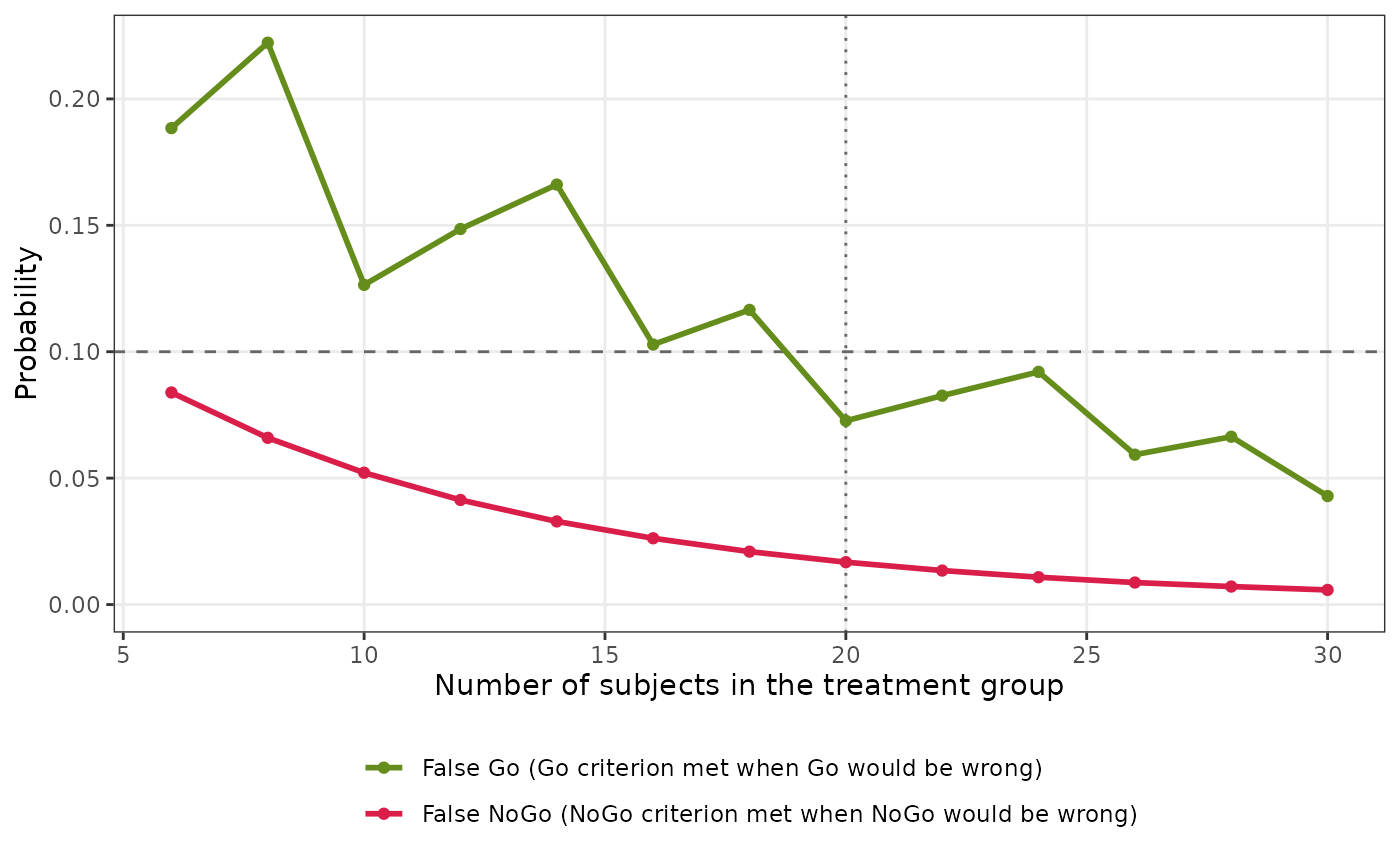
n_t = seq(6, 30, by = 2))
res
#> Search for the sample size (exact enumeration of the outcomes)
#> Targets: P(Go criterion met | scenario_go) <= 0.1 and P(NoGo criterion met | scenario_nogo) <= 0.1
#> Smallest candidate that meets the targets: n_t = 20, n_c = 20
#> P(Go criterion met | scenario_go) = 0.07267
#> P(NoGo criterion met | scenario_nogo) = 0.01676
#> Probabilities for the candidate sample sizes
#> n_t n_c prob_go prob_nogo met
#> 6 6 0.18844 0.083872 FALSE
#> 8 8 0.22223 0.065947 FALSE
#> 10 10 0.12644 0.052145 FALSE
#> 12 12 0.14854 0.041368 FALSE
#> 14 14 0.16612 0.032875 FALSE
#> 16 16 0.10285 0.026211 FALSE
#> 18 18 0.11655 0.020935 FALSE
#> 20 20 0.07267 0.016762 TRUE
#> 22 22 0.08263 0.013449 TRUE
#> 24 24 0.09203 0.010812 TRUE
#> 26 26 0.05929 0.008708 TRUE
#> 28 28 0.06637 0.007121 TRUE
#> 30 30 0.04292 0.005780 TRUE
#> Decision probabilities with the chosen sample size
#> scenario pi_t pi_c Go NoGo Gray Miss
#> scenario_go 0.4 0.4 0.07267 0.43615 0.4912 0
#> scenario_nogo 0.7 0.4 0.69555 0.01676 0.2877 0
plot(res)
 res$design
#> Design: one binary endpoint
#> Treatment: n = 20, prior Beta(a = 0.5, b = 0.5)
#> Control: concurrent, n = 20, prior Beta(a = 0.5, b = 0.5)
#> Posterior probability criterion
#> Go: P(theta > 0.2 | data) >= 0.5
#> NoGo: P(theta <= 0.1 | data) >= 0.8